Back to: Artifical Intelligence
Machine learning
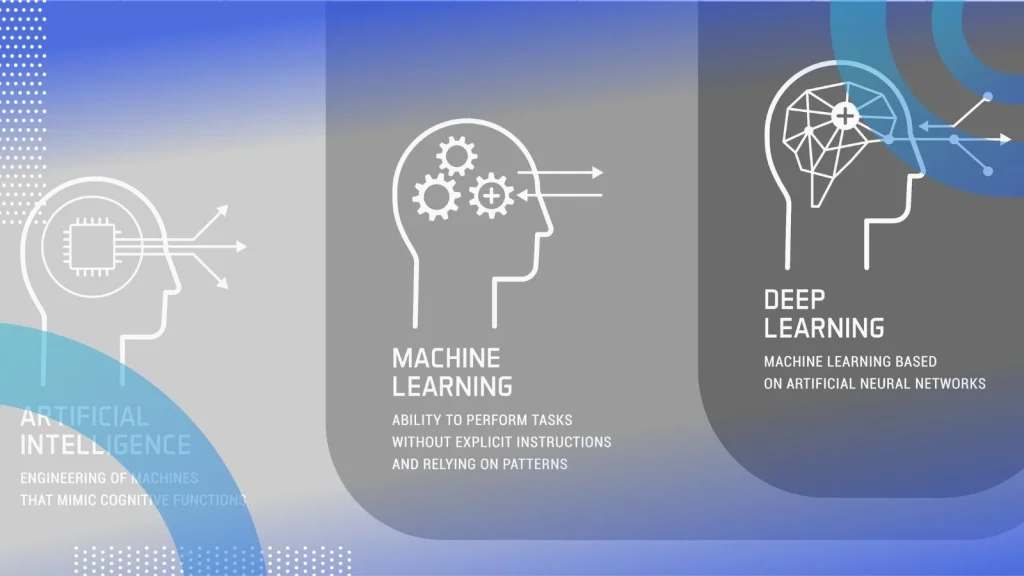
When most people mention AI, they’re usually talking about machine learning. This term covers algorithms that get better with experience, without needing specific instructions for every improvement. Examples of such algorithms include evolutionary algorithms, Markov chains, and neural networks.
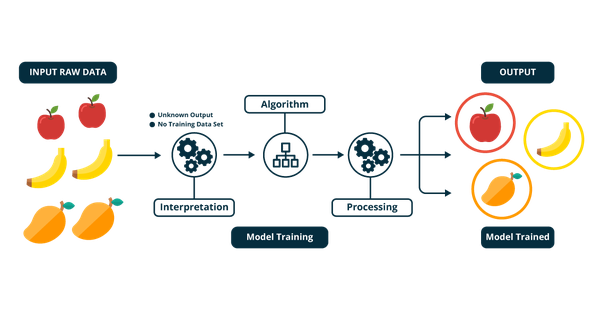
Machine learning (ML) is a specific field within artificial intelligence (AI) that focuses on enabling computers to learn and improve from data without being explicitly programmed. Instead of relying on predefined rules, ML algorithms identify patterns in data and make decisions or predictions based on those patterns.
ML algorithms are trained on large datasets, and the more data they are exposed to, the better they become at recognizing patterns and making accurate predictions.

Neural networks
Neural networks are algorithms, modelled after the human brain, that use a system of interconnected nodes called artificial neurons. This allows them to be trained, so that when given complex data, they can produce desired outputs. For example, let’s say we wanted a network that can recognise cats. We would give it two sets of images containing “cats” and “not cats”. Then neurons will apply mathematical operations to the image and produce a first guess. This guess is usually incorrect, however the network then adjusts these calculations until it responds to features of the training data (such as tails or whiskers) and starts being correct more often. Once training is complete, the network can be given new images. It will then use those features it learned during training to calculate the likelihood that any given image is a cat.
A neural network is a type of machine learning algorithm that mimics the human brain’s structure and function, using interconnected nodes called neurons to process data and make predictions. These networks are a fundamental part of deep learning, a subfield of AI, and are widely used for tasks like image recognition and natural language processing.
Deep learning
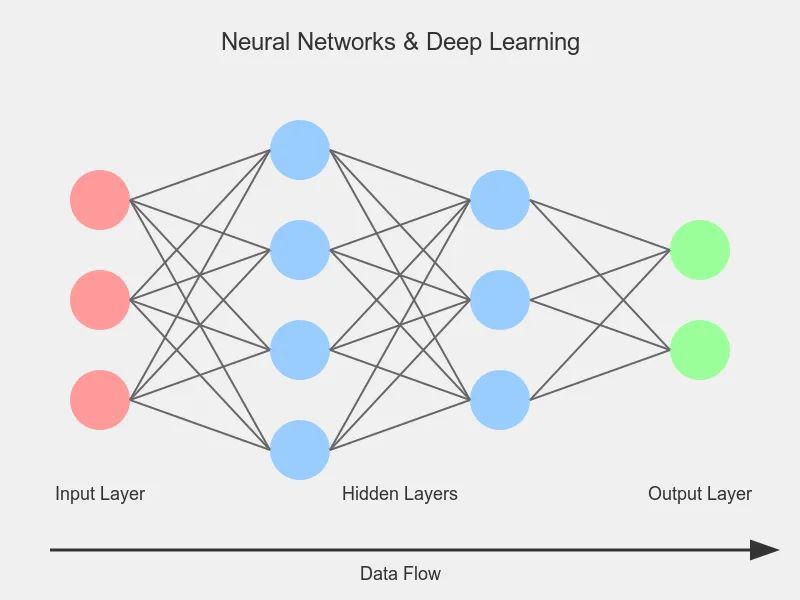
More complex problems require more artificial neurons. These neurons are usually arranged into “layers”. When there are many of these layers, it is referred to as a “deep” neural network. These are harder to train, requiring more data, but they can complete many more operations on inputs, making them better suited to complex tasks. This type of neural network is usually the kind you hear about playing board games, generating images or interpreting natural language.
Deep learning is a specialised area within artificial intelligence and machine learning that utilises artificial neural networks with multiple layers to analyse data and learn from it. These networks are inspired by the structure and function of the human brain, allowing computers to recognise patterns, make predictions, and solve complex problems. Deep learning is particularly effective at handling large, unstructured datasets and tasks like image and speech recognition, natural language processing, and more.
Here’s a more detailed explanation:
- Artificial Neural Networks: Deep learning relies on artificial neural networks (ANNs), which are systems of interconnected nodes (artificial neurons) organized in layers.
- Multiple Layers: The “deep” in deep learning refers to the multiple layers within these networks, allowing them to learn complex representations of data.
- Learning from Data: Deep learning algorithms learn from vast amounts of data, identifying patterns and relationships within it, and improving their performance over time.
- Applications: Deep learning powers many modern AI applications, such as:
- Image Recognition: Identifying objects and features in images.
- Natural Language Processing: Understanding and generating human language.
- Speech Recognition: Converting spoken words into text.
- Robotics: Enabling robots to perform tasks autonomously.
- Fraud Detection: Identifying suspicious patterns in financial transactions.
- Relationship to AI and Machine Learning: Deep learning is a subset of machine learning, which is a broader field of AI focused on enabling computers to learn from data without explicit programming.