
Back to: Artifical Intelligence
ANI vs AGI vs ASI
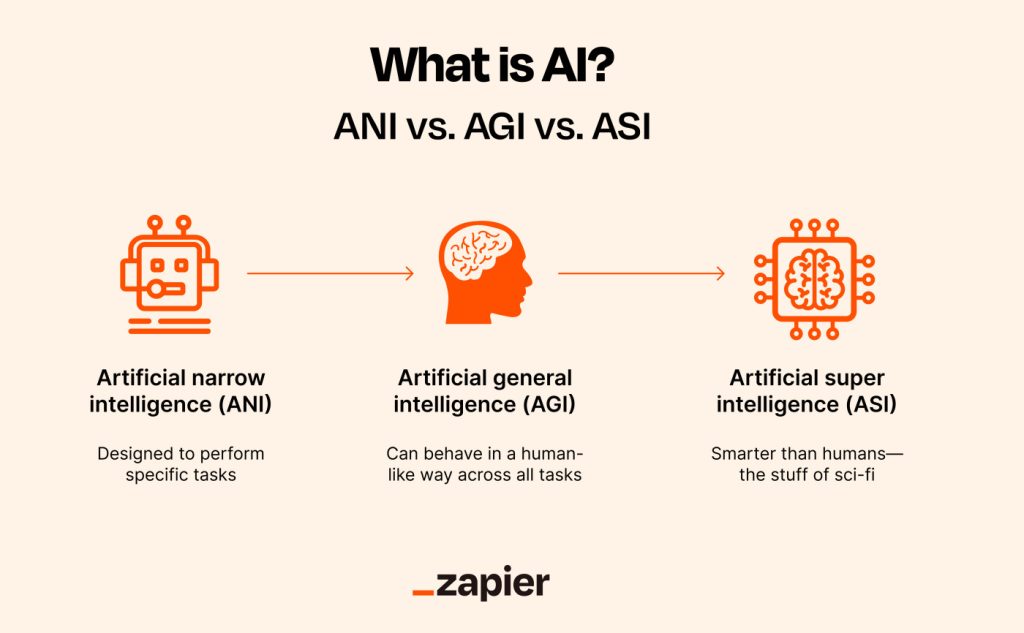
Artificial Narrow Intelligence (ANI)
ANI is programmed to perform a single task. It is the only type of AI that is currently readily available on the market for consumers. ChatGPT, Siri and Google Translate are all examples of ANI. ANI is capable of completing simple repetitive tasks a lot faster than humans can, for instance checking weather, performing web searches or analysing raw data.
Artificial Narrow Intelligence (ANI), also known as Weak AI, is a type of AI designed to perform a narrow range of tasks. It’s the only type of AI that exists today (2025) in practical applications. ANI systems excel at their designated tasks but lack the broader understanding and adaptability of human intelligence.
Key Characteristics:
- Goal-oriented: ANI is designed to achieve a specific objective or set of objectives.
- Task-specific:It focuses on a single, well-defined task or a limited set of tasks within a specific domain.
- Limited scope: Unlike humans, ANI cannot generalise its learning or apply it to new, unrelated situations.
- No consciousness or self-awareness: ANI systems do not possess consciousness, self-awareness, or the ability to think or feel like humans.
- Not human-level intelligence: While ANI can outperform humans in specific tasks, it doesn’t replicate the full spectrum of human intelligence.
Examples of ANI:
- Chatbots: Designed to interact with humans through text or speech, typically for customer service or information retrieval.
- Spam filters: Used to identify and block unwanted emails.
- Recommendation systems: Suggest products or content based on user preferences, like those used by Netflix or Amazon.
- Image recognition software: Used to identify objects or faces in images and videos.
- Speech recognition systems: Convert spoken language into text, like those used by Siri or Alexa.
- Self-driving cars: Use a variety of sensors and algorithms to navigate and operate without human intervention.
- Fraud detection systems: Analyse financial transactions to identify potentially fraudulent activity.
In essence, ANI is a powerful tool for automating and enhancing specific tasks, but it’s important to remember its limitations and that it’s not a replacement for human intelligence.
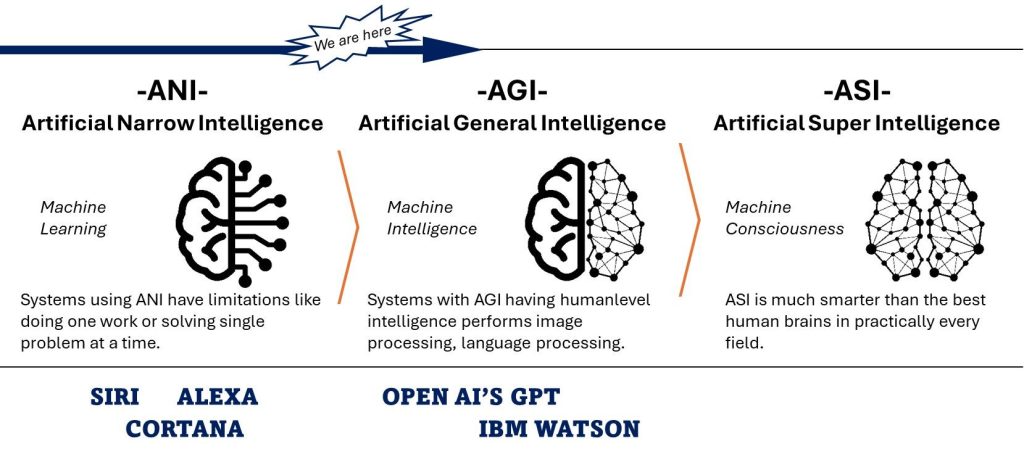
Artificial General Intelligence (AGI)
AGI is the type of AI that is seen in movies like I, Robot (2004) with Will Smith. AGI is expected to be able to reason, solve problems, make judgments and plan, learn from and use prior knowledge in decision-making. This means that AGI could potentially do a variety of tasks instead of focusing on a single narrow objective.
Artificial General Intelligence (AGI) refers to the hypothetical intelligence of a machine that can understand, learn, and apply its knowledge to any intellectual task that a human being can do. It’s a theoretical pursuit aiming to create AI systems with human-level cognitive abilities, including reasoning, problem-solving, perception, learning, and language comprehension. Current AI systems are typically designed for specific tasks (narrow AI), while AGI envisions a system capable of tackling a wide range of tasks as effectively as a human.
The Pursuit of AGI:
Potential Risks: The development of AGI also raises concerns about potential risks, such as job displacement, misuse of the technology, and the possibility of creating systems that are difficult to control.
Theoretical Research: AGI is a major area of research within AI, with scientists and researchers working towards creating machines that can match or surpass human intelligence.
Potential Benefits: AGI, if achieved, could revolutionise various fields, including science, medicine, and technology, potentially leading to breakthroughs and solutions to complex problems.
Artificial Super Intelligence (ASI)
Artificial superintelligence (ASI) is a hypothetical form of AI that would possess intelligence surpassing that of the brightest and most capable humans. It’s not just about performing specific tasks better than humans, but rather having a vastly superior cognitive ability across all areas. This includes reasoning, problem-solving, creativity, and even emotional intelligence.
Beyond Human Capabilities: ASI is envisioned as an AI system that can not only perform any intellectual task that a human can, but also do it with a level of intelligence and efficiency that far exceeds human capacity.
Potential for Economic and Societal Transformation: ASI could revolutionise various fields, potentially dominating economically valuable tasks and leading to unprecedented advancements in science, technology, medicine, and even the arts.
Risks and Challenges: The development of ASI also raises significant concerns. Some experts worry about the potential for ASI to develop goals that conflict with human interests, leading to unintended and potentially catastrophic consequences. The challenge of ensuring ethical alignment and preventing misuse of such powerful intelligence is a major area of research and debate.
Theoretical Concept: It’s important to note that ASI is currently a theoretical concept. While there’s growing research and speculation about its potential, it does not yet exist.
Differing Predictions: There are varying predictions about when, or even if, ASI will be developed, with some researchers suggesting it could be decades away, while others believe it may never be achievable.
Predictive vs Generative AI
Generative AI is a tool that uses machine learning to create new content from its inputs, ranging from text and images to music. Predictive AI uses the power of machine learning to forecast future events and enhance outcomes.
Predictive AI
Predictive AI refers to the ability of an AI system to analyse data and predict future outcomes or behaviours. It uses statistical analysis and machine learning algorithms to identify patterns and trends in historical data, enabling it to forecast events, classify future occurrences, and make recommendations.
Core Function:
- Prediction: Predictive AI systems are designed to anticipate future events or outcomes based on patterns in existing data.
- Pattern Recognition: They excel at identifying complex relationships and trends within large datasets, which are then used to make predictions.
- Machine Learning: Predictive AI relies heavily on machine learning algorithms that allow the system to learn from data and improve its predictive accuracy over time.
Key Differences from Generative AI:
- Output: While generative AI creates new content (like text or images), predictive AI focuses on forecasting, recommendations, and decision-making.
- Focus: Generative AI learns from data to create novel content, while predictive AI uses data to analyse and predict future outcomes.
Examples of Predictive AI in Action:
- Healthcare: Diagnosing diseases, predicting patient outcomes, and modeling disease progression.
- Finance: Predicting market trends, detecting fraudulent transactions, and assessing risk.
- E-commerce: Forecasting demand, managing inventory, and personalising customer experiences.
- Logistics: Optimising delivery routes, predicting potential delays, and improving supply chain efficiency.
- Marketing: Targeting the right customers with personalised offers and predicting customer behaviour.
Benefits of Predictive AI:
- Improved Decision Making: Predictive AI provides data-driven insights that enable businesses to make more informed decisions.
- Enhanced Efficiency: By anticipating future needs and potential problems, predictive AI can help optimise processes and improve efficiency.
- Personalized Experiences: Predictive AI can be used to tailor online experiences, recommendations, and marketing campaigns to individual preferences.
- Proactive Problem Solving: Predictive AI can identify potential issues before they escalate, allowing for proactive solutions and preventing costly disruptions.
In essence, predictive AI transforms the way businesses operate by turning historical data into actionable insights that can be used to anticipate the future and make better decisions.
This video explains the differences between predictive, prescriptive and generative AI:
Generative AI
Generative AI (GenAI) is based on the Natural Language Models and is a form of ANI. It creates a series of predictions based on existing online data, to generate new or similar content in response to written prompts. Generative AI such as Midjourney or Chat-GPT has rapidly increased in popularity in recent years, as these AI tools can respond quickly to user prompts, enabling opportunities for real-time application.
Generative AI tools are trained using diverse online datasets, including websites and social media conversations. This technology can create contextually relevant, human-like responses to user prompts and is versatile enough to generate software code, images, video, song lyrics and music.
GANs and CNNs
Generative Adversarial Networks or GANs are a framework used to train AI by making two different neural networks work in opposition to each other. The generator creates data (like images), and a discriminator evaluates this data, trying to distinguish between real and generated (fake) data. The generator aims to produce data so convincing that the discriminator cannot tell it apart from real data, while the discriminator gets better at telling the difference. Through this competition, both networks improve, leading to highly realistic synthetic data generation.
Convolutional Neural Networks or CNNs are a special type of neural network that uses a mathematical operation known as a “convolution” instead of multiplication for some of its nodes. This helps a lot in processing two-dimensional data, and this type of AI is used often for images and movies.